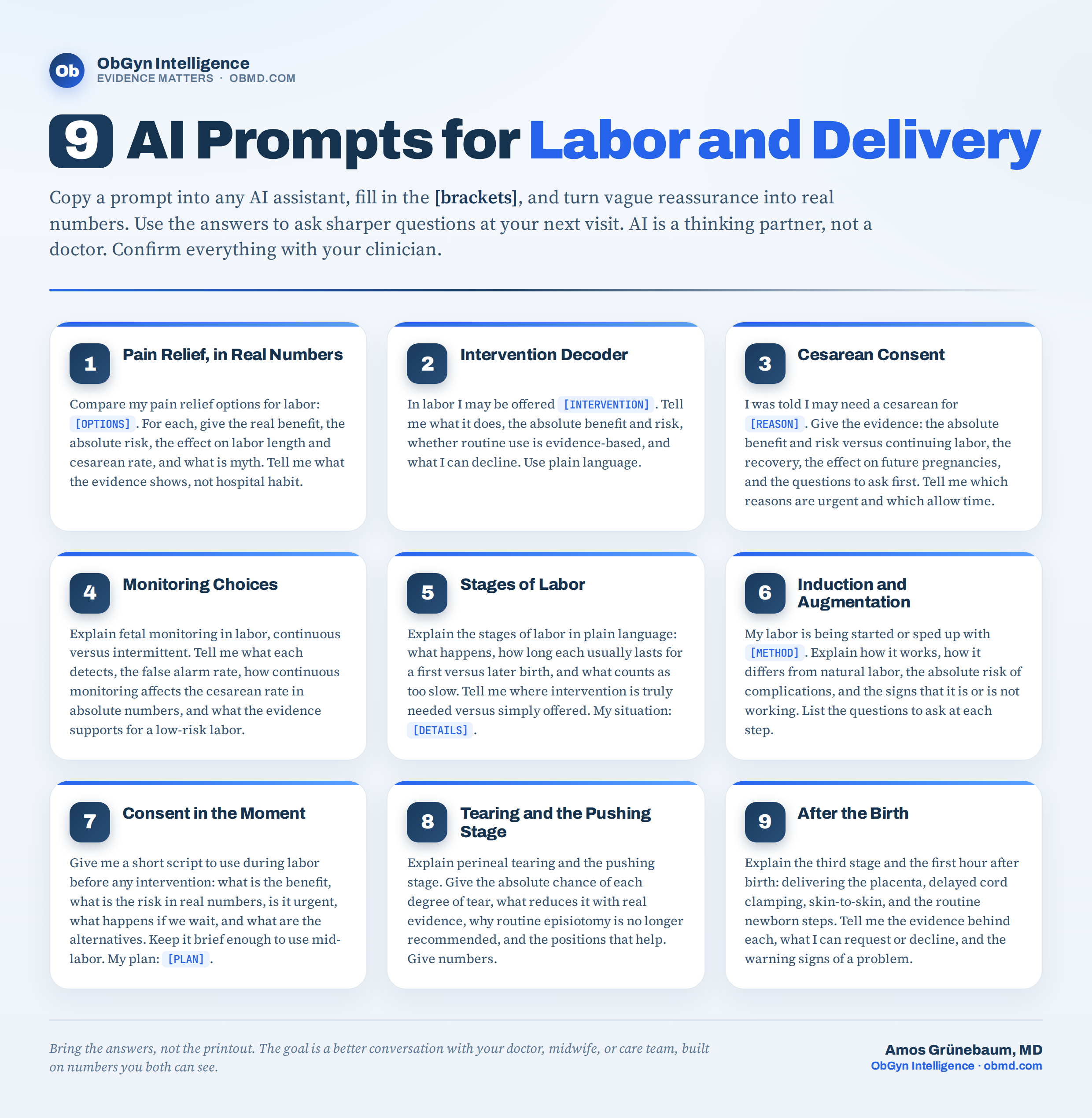
Copy any prompt into a chatbot, fill in the brackets, and turn vague reassurance into real numbers. Use the answers to ask sharper questions at your next visit. These are starting points for a better conversation, not a substitute for one.
Tap Copy on any card, paste it into your AI assistant, and replace the blue brackets with your own details.
Compare my pain relief options for labor: [OPTIONS]. For each, give the real benefit, the absolute risk, the effect on labor length and cesarean rate, and what is myth. Tell me what the evidence shows, not hospital habit.
In labor I may be offered [INTERVENTION]. Tell me what it does, the absolute benefit and risk, whether routine use is evidence-based, and what I can decline. Use plain language.
I was told I may need a cesarean for [REASON]. Give the evidence: the absolute benefit and risk versus continuing labor, the recovery, the effect on future pregnancies, and the questions to ask first. Tell me which reasons are urgent and which allow time.
Explain fetal monitoring in labor, continuous versus intermittent. Tell me what each detects, the false alarm rate, how continuous monitoring affects the cesarean rate in absolute numbers, and what the evidence supports for a low-risk labor.
Explain the stages of labor in plain language: what happens, how long each usually lasts for a first versus later birth, and what counts as too slow. Tell me where intervention is truly needed versus simply offered. My situation: [DETAILS].
My labor is being started or sped up with [METHOD]. Explain how it works, how it differs from natural labor, the absolute risk of complications, and the signs that it is or is not working. List the questions to ask at each step.
Give me a short script to use during labor before any intervention: what is the benefit, what is the risk in real numbers, is it urgent, what happens if we wait, and what are the alternatives. Keep it brief enough to use mid-labor. My plan: [PLAN].
Explain perineal tearing and the pushing stage. Give the absolute chance of each degree of tear, what reduces it with real evidence, why routine episiotomy is no longer recommended, and the positions that help. Give numbers.
Explain the third stage and the first hour after birth: delivering the placenta, delayed cord clamping, skin-to-skin, and the routine newborn steps. Tell me the evidence behind each, what I can request or decline, and the warning signs of a problem.
How to use these well. AI can fabricate numbers, references, and doses that look correct. Ask it to separate evidence from inference and to say when it is unsure. Bring the answers to your doctor, midwife, or care team and check them together. The goal is a better conversation built on numbers you both can see, not a diagnosis from a chatbot.